EcoFlow DELTA 2 & DJI Power 1000 share many similarities, but there are also important differences, such as quality, performance, features, design, and connectivity. If you want the best one between them, I Would recommend the EcoFlow DELTA 2 rather than the DJI Power 1000.
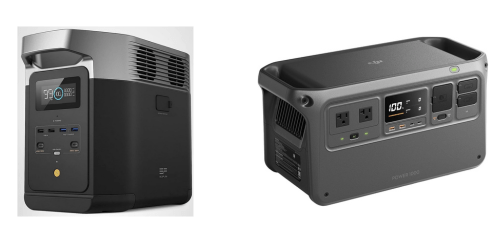
Why Do I Recommend The EcoFlow DELTA 2?
- The EcoFlow Delta 2 has expandable battery capacity support for extending runtime with official extra batteries during long outages or multi-day off-grid use, while the DJI Power 1000 uses a fixed-capacity design without official battery expansion.
- EcoFlow Delta 2 supports a wider solar input voltage range to allow easier compatibility with different portable and rigid solar panel setups, whereas the DJI Power 1000 uses a narrower DC input range that limits panel configuration flexibility.
- It includes a built-in 12V car socket to directly power automotive accessories and portable fridges without adapters, while the DJI Power 1000 does not include a dedicated 12V car output.
- The EcoFlow Delta 2 comes with multiple DC barrel outputs for running routers, CPAP machines, and DC appliances more efficiently, whereas the DJI Power 1000 relies primarily on USB and proprietary DC ports.
- EcoFlow Delta 2 supports faster practical recharge times from AC power to restore usable capacity more quickly between outages or trips, while the DJI Power 1000 generally takes longer to reach the same charge level.
- It includes a higher number of AC outlets to power multiple household devices at the same time without power strips, whereas the DJI Power 1000 provides fewer AC sockets.
- The EcoFlow Delta 2 features broader ecosystem compatibility with EcoFlow accessories such as extra batteries and alternator chargers for flexible energy setups, while the DJI Power 1000 focuses mainly on DJI-specific ecosystem accessories.
- EcoFlow Delta 2 comes with a longer standard warranty period for better long-term ownership confidence and reduced replacement risk, whereas the DJI Power 1000 includes a shorter default warranty.
Maybe the DJI Power 1000 price can make you comfortable because it’s a little bit cheaper than the EcoFlow DELTA 2. But you have to compromise all the above-mentioned features. Now the Decision is Yours. I hope it was helpful to choose the right one.
Side By Side Comparison
| Feature | EcoFlow DELTA 2 | DJI Power 1000 |
| Max/boosted AC load | X-Boost up to 2400 W | 2600 W (short-duration) |
| AC outlets | 4 / 6 | 2 |
| USB-A ports | 2×12 W + 2×18 W | 2×24 W |
| 12V car socket | 12.6 V 10 A | None |
| DC barrel outputs | 2×DC5521 | None |
| Solar/DC input type | MC4 → XT60 | SDC/SDC Lite (via adapter) |
| Solar input rating | 11–60 V, 15 A, 500 W | 32–58.4 V DC |
| Expandable capacity | Up to 2048 Wh / 3040 Wh | No official capacity expansion |
| Cycle life spec | 3000 cycles to 80% | 4000 cycles to 70% |
| Net weight | ~12 kg | ~13 kg |
| Warranty | 5 years | 3 years |
| Price | Check DELTA 2 Price | Check DJI 1000 Price |
What Common Both Can Do?
- Battery capacity class: Both power stations fall into the 1 kWh class, making them suitable for running essential appliances, electronics, and tools for several hours. This capacity level is a common sweet spot for home backup, camping, and mobile work scenarios.
- Battery chemistry: Both use LFP (LiFePO₄) batteries, which are known for long cycle life, improved thermal stability, and safer operation compared to older lithium-ion chemistries. This matters for users who plan to recharge frequently over many years.
- Pure sine wave inverter: Each model delivers pure sine wave AC output, which is critical for safely powering sensitive electronics such as laptops, medical devices, and modern appliances. This ensures stable voltage and reduced risk of electrical noise or damage.
- Portable power station form factor: Both units are designed as all-in-one portable power stations with integrated battery, inverter, ports, and cooling. This makes them easy to transport and deploy without additional components.
- AC power output: EcoFlow Delta 2 and DJI Power 1000 both provide standard AC outlets for household-style devices. This allows them to function as temporary replacements for wall power during outages or off-grid use.
- DC power output: Each unit includes DC output capability for powering devices that do not require AC conversion. This improves efficiency when charging compatible equipment directly from DC power.
- USB charging support: Both models include USB ports for directly charging phones, tablets, cameras, and accessories. This eliminates the need for separate chargers and adapters.
- USB-C Power Delivery: Each supports USB-C PD, enabling fast charging for modern laptops, tablets, and smartphones. This is especially important for users relying on USB-C as a primary charging standard.
- Fast AC recharging: Both units support high-speed AC input, allowing them to recharge in a relatively short time compared to older power stations. Faster recharging reduces downtime between uses or outages.
- Solar charging support: EcoFlow Delta 2 and DJI Power 1000 can both be recharged using solar panels. This enables off-grid operation and renewable energy use during extended outdoor trips or emergencies.
- Car charging support: Each model supports charging from a vehicle power source, making them practical for road trips, overlanding, and mobile work setups. This adds flexibility when grid power is unavailable.
- App-based control: Both power stations can be monitored and controlled through a dedicated mobile app. App control allows users to check battery status, input/output power, and settings remotely.
- Wi-Fi connectivity: Wi-Fi support enables remote monitoring and control when the unit is connected to a network. This is useful for home backup scenarios where the unit may be placed out of direct reach.
- Bluetooth connectivity: Bluetooth provides a local, offline connection option for controlling the power station. This ensures access even when Wi-Fi is unavailable.
- EPS/UPS-style backup: Both units support emergency power supply functionality, allowing them to switch to battery power during grid outages. This is important for keeping essential devices running with minimal interruption.
- Thermal protection system: Each power station includes active thermal management to prevent overheating under heavy loads. Proper temperature control helps maintain performance and extend component lifespan.
- Overload protection: Both models include overload protection to shut down safely if power demand exceeds limits. This protects both the power station and connected devices.
- Short-circuit protection: Built-in short-circuit protection enhances safety by immediately cutting power in fault conditions. This reduces the risk of damage or fire.
- Indoor/outdoor use: EcoFlow Delta 2 and DJI Power 1000 are designed for flexible use in both indoor and outdoor environments. This versatility makes them suitable for home backup, travel, and professional field use.
Common Features
| Feature | EcoFlow DELTA 2 | DJI Power 1000 |
| Battery capacity class | 1024 Wh | 1024 Wh |
| Battery chemistry | LFP (LiFePO₄) | LFP (LiFePO₄) |
| Pure sine wave inverter | Yes | Yes |
| Portable power station form factor | Yes | Yes |
| AC power output | Yes | Yes |
| DC power output | Yes | Yes |
| USB charging support | Yes | Yes |
| USB-C Power Delivery | Yes | Yes |
| Fast AC recharging | Yes | Yes |
| Solar charging support | Yes | Yes |
| Car charging support | Yes | Yes |
| App-based control | Yes | Yes |
| Wi-Fi connectivity | Yes | Yes |
| Bluetooth connectivity | Yes | Yes |
| EPS/UPS-style backup | Yes | Yes |
| Thermal protection system | Yes | Yes |
| Overload protection | Yes | Yes |
| Short-circuit protection | Yes | Yes |
| Indoor/outdoor use | Yes | Yes |
| Price | Check DELTA 2 Price | Check DJI 1000 Price |