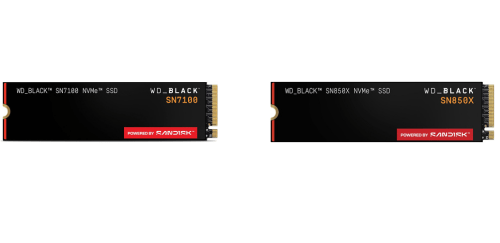
WD Black SN7100 & WD Black SN850X share many similarities, but there are also important differences, such as quality, performance, features, design, and connectivity. If you want the best one between them, I Would recommend the WD Black SN7100 rather than the WD Black SN850X.
Why Do I Recommend The WD Black SN7100?
- The WD Black SN7100 features a lighter single-sided M.2 2280 design for better compatibility with thin laptops and restricted motherboard slots, whereas the WD Black SN850X uses heavier designs that can vary by capacity and heatsink configuration.
- WD Black SN7100 includes a 500GB capacity option for more affordable entry-level Gen4 upgrades and OS-only installations, while the WD Black SN850X starts at higher capacities focused on premium builds.
- It has higher random write IOPS at comparable capacities for faster small-file operations and system-level responsiveness, whereas the WD Black SN850X prioritizes higher random read performance.
- The WD Black SN7100 supports a consistent single design across capacities for easier thermal planning and predictable fitment, while the WD Black SN850X uses multiple physical variants depending on capacity and heatsink choice.
- WD Black SN7100 comes with competitive Gen4 sequential write speeds for sustained everyday workloads like installs and file transfers, while the WD Black SN850X emphasizes peak read speeds.
- It features simpler no-heatsink-only configuration for hassle-free installation under motherboard shields and laptop covers, whereas the WD Black SN850X requires heatsink selection considerations.
- WD Black SN7100 comes with a lower power consumption profile for improved efficiency and longer battery life in laptops and compact systems, while the WD Black SN850X uses a higher-performance power profile optimized.
Maybe the WD Black SN850X can make you comfortable because it’s a little bit cheaper than the WD Black SN7100. But you have to compromise all the above-mentioned features. Now the Decision is Yours. I hope it was helpful to choose the right one.
Side-by-Side Comparison
| Feature | WD Black SN7100 | WD Black SN850X |
| Sequential write (1TB) | 6,900MB/s | 6,300MB/s |
| Sequential write (2TB) | 6,900MB/s | 6,600MB/s |
| Sequential write (4TB) | 6,700MB/s | 6,600MB/s |
| Random read (1TB) | 1,000K IOPS | 800K IOPS |
| Random write (1TB) | 1,400K IOPS | 1,100K IOPS |
| Random write (2TB) | 1,400K IOPS | 1,100K IOPS |
| Random read (4TB) | 900K IOPS | 1,200K IOPS |
| Random write (4TB) | 1,350K IOPS | 1,100K IOPS |
| Endurance TBW (500GB) | 300TBW | N/A |
| Dimensions (single design) | 80mm x 22mm x 2.38mm | Varies by capacity + heatsink option |
| Weight (single design) | 5.8g | 7.5g , 8.6g |
| 500GB model | Yes | No |
| Price | Check WD Black SN7100 Price | Check WD Black SN850X Price |
What Common Both Can Do?
- NVMe protocol: Both drives use the NVMe protocol, which is designed specifically for solid-state storage over PCIe. This enables lower latency and higher parallelism compared to older SATA-based SSDs.
- PCIe generation: Each model supports PCIe Gen4, allowing significantly higher bandwidth than PCIe Gen3. This matters for fast boot times, quick file transfers, and reduced load times in demanding applications.
- PCIe lanes: Both drives operate over a PCIe x4 connection, which is the standard configuration for high-performance NVMe SSDs. This ensures they can fully utilize the available Gen4 bandwidth.
- Form factor: The M.2 2280 form factor is shared by both drives, making them compatible with most modern desktops and laptops. This common size simplifies upgrades and system integration.
- NAND type: Both SSDs use 3D NAND flash memory, which stacks memory cells vertically. This improves storage density, efficiency, and long-term reliability.
- NVMe version: Support for NVMe 1.4 on both models ensures compatibility with modern operating systems and platforms. It also enables advanced power management and performance features.
- DRAM-less design: Both drives operate without dedicated onboard DRAM. Instead, they rely on system memory and firmware optimizations to balance cost, efficiency, and performance.
- Host Memory Buffer: Each model supports Host Memory Buffer technology, allowing the SSD to use a portion of system RAM for mapping data. This helps improve responsiveness compared to older DRAM-less designs.
- TRIM support: TRIM support allows the operating system to inform the SSD which blocks are no longer in use. This helps maintain consistent performance and prolongs the lifespan of the drive.
- Garbage collection: Both drives include internal garbage collection mechanisms to reorganize data efficiently. This ensures sustained performance during long-term use.
- SMART monitoring: SMART support on both models enables health monitoring and diagnostics. Users can track drive condition and anticipate potential issues before failure.
- Wear leveling: Wear leveling is present on both SSDs to distribute writes evenly across memory cells. This is critical for maintaining endurance and reliability over time.
- End-to-end data path protection: Both drives include data integrity mechanisms to reduce the risk of corruption during data transfers. This is especially important for system stability and file safety.
- Firmware updatable: Firmware on both models can be updated by the user. This allows performance tuning, bug fixes, and compatibility improvements over the drive’s lifespan.
- SanDisk Dashboard support: Both SSDs are compatible with the SanDisk Dashboard software. This provides tools for monitoring health, updating firmware, and managing drive settings.
- Gaming-focused branding: Each drive is positioned under the WD Black gaming lineup. This indicates tuning and validation aimed at fast load times and responsive system behavior.
- Desktop compatibility: Both SSDs are designed for use in desktop PCs with M.2 NVMe slots. This makes them suitable for gaming rigs, workstations, and general-purpose systems.
- Laptop compatibility: The shared M.2 2280 format and Gen4 support make both drives suitable for modern laptops. This enables fast storage upgrades without special adapters.
- Operating system support: Both drives support modern Windows operating systems starting from Windows 10. This ensures full feature support, driver compatibility, and optimal performance.
Common Features
| Feature | WD Black SN7100 | WD Black SN850X |
| NVMe protocol | Yes | Yes |
| PCIe generation | PCIe Gen4 | PCIe Gen4 |
| PCIe lanes | x4 | x4 |
| Form factor | M.2 2280 | M.2 2280 |
| NAND type | 3D NAND | 3D NAND |
| NVMe version | NVMe 1.4 | NVMe 1.4 |
| DRAM-less design | Yes | Yes |
| Host Memory Buffer | Yes | Yes |
| TRIM support | Yes | Yes |
| Garbage collection | Yes | Yes |
| SMART monitoring | Yes | Yes |
| Wear leveling | Yes | Yes |
| End-to-end data path protection | Yes | Yes |
| Firmware updatable | Yes | Yes |
| SanDisk Dashboard support | Yes | Yes |
| Gaming-focused branding | Yes | Yes |
| Desktop compatibility | Yes | Yes |
| Laptop compatibility | Yes | Yes |
| Operating system support | Windows 10+ | Windows 10+ |
| Price | Check WD Black SN7100 Price | Check WD Black SN850X Price |
FAQ
Which SSD is faster for gaming and heavy workloads? Are both SSDs compatible with PCIe Gen4 systems? Do both drives use the same form factor? Is there a difference in maximum storage capacity? Do both SSDs support NVMe 1.4? Are these SSDs DRAM-less? Is Host Memory Buffer supported on both models? Do both drives support TRIM and garbage collection? Are these SSDs suitable for PlayStation 5? Do both SSDs support firmware updates? Is monitoring software available for both drives? How do endurance levels compare between the two drives? Are both drives suitable for laptops as well as desktops? Which SSD is better for long-term high-performance use? |