Quick Deal Access

GeForce RTX 3070 vs 4060 Ti – Check Which One Is Best & Why?

GeForce RTX 4060 Ti & GeForce RTX 3070 share many similarities, but there are also important differences, such as quality, performance, features, design, and connectivity. If you want the best one between them, I Would recommend the GeForce RTX 4060 Ti rather than the GeForce RTX 3070. 
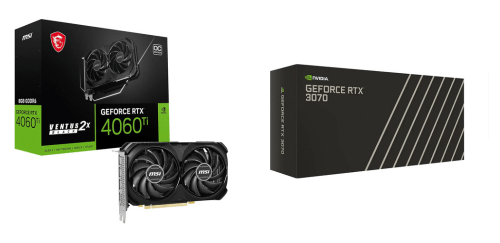
Why Do I Recommend The GeForce RTX 4060 Ti

  • The GeForce RTX 4060 Ti features DLSS 3 Frame Generation to significantly boost perceived frame rates and smoothness in supported games, while the GeForce RTX 3070 supports DLSS 2 without frame generation.
  • GeForce RTX 4060 Ti comes with Ada Lovelace architecture for higher performance per watt and improved efficiency in long gaming sessions, whereas the GeForce RTX 3070 uses the older Ampere architecture.
  • It includes fourth-generation Tensor Cores to accelerate AI-driven upscaling and image reconstruction with greater accuracy, while the GeForce RTX 3070 comes with third-generation Tensor Cores.
  • The GeForce RTX 4060 Ti has third-generation ray tracing cores for faster and more efficient real-time lighting and reflections, whereas the GeForce RTX 3070 uses second-generation ray tracing cores.
  • GeForce RTX 4060 Ti supports AV1 hardware encoding to deliver higher-quality streams and recordings at lower bitrates, while the GeForce RTX 3070 lacks AV1 encoding support.
  • It comes with a much larger L2 cache to reduce memory latency and improve performance consistency in modern games, while the GeForce RTX 3070 has a significantly smaller cache.
  • The GeForce RTX 4060 Ti features substantially lower power consumption to enable quieter cooling and smaller power supply requirements, while the GeForce RTX 3070 draws noticeably more power.
  • GeForce RTX 4060 Ti supports an optional 16GB VRAM configuration to better handle future games with large textures and higher memory demands, whereas the GeForce RTX 3070 is limited to 8GB of VRAM.

Maybe the GeForce RTX 3070 price can make you comfortable because it’s a little bit cheaper than the GeForce RTX 4060 Ti. But you have to compromise all the above-mentioned features. Now the Decision is Yours. I hope it was helpful to choose the right one.

Side By Side Comparison

FeatureGeForce RTX 4060 TiGeForce RTX 3070
ArchitectureAda LovelaceAmpere
Process NodeTSMC 4NSamsung 8nm
CUDA Cores43525888
Base Clock~2310 MHz~1500 MHz
Boost Clock~2535 MHz~1725 MHz
Memory Capacity8GB / 16GB8GB
L2 Cache32 MB4 MB
PCIe InterfacePCIe 4.0 x8PCIe 4.0 x16
Ray Tracing Cores3rd Gen2nd Gen
Tensor Cores4th Gen3rd Gen
DLSS SupportDLSS 3DLSS 2
AV1 EncodingYesNo
Transistor Count~22.9B~17.4B
Launch MSRP TierMid-rangeUpper mid-range
PriceCheck 4060 Ti PriceCheck RTX 3070 Price

What Common Both Can Do?

  • NVIDIA GeForce RTX Series: Both graphics cards belong to the GeForce RTX lineup, which is designed to deliver advanced gaming and graphics capabilities using NVIDIA’s RTX platform. This ensures access to modern features like ray tracing, AI acceleration, and gaming-focused optimizations.
  • Desktop GPU Segment: Both models are designed specifically for desktop systems, making them suitable for gaming PCs, workstations, and custom-built rigs. This allows users to benefit from higher power limits and better cooling compared to mobile GPUs.
  • PCI Express 4.0 Support: Both GPUs support PCIe 4.0, enabling high-bandwidth communication with modern motherboards. This ensures compatibility with current platforms and helps avoid interface-related bottlenecks.
  • GDDR6 Memory Type: Each card uses GDDR6 memory, providing fast data transfer rates needed for high-resolution textures and modern game assets. This memory type balances performance, efficiency, and stability for gaming workloads.
  • Hardware Ray Tracing: Both GPUs include dedicated ray tracing hardware, allowing games to render realistic lighting, reflections, and shadows. This enhances visual realism in supported titles without relying solely on software-based techniques.
  • Tensor Cores for AI: Each model includes Tensor Cores that accelerate AI-based tasks such as upscaling and image reconstruction. These cores are essential for features like DLSS and other AI-enhanced graphics technologies.
  • NVIDIA DLSS Support: Both GPUs support NVIDIA DLSS, enabling higher frame rates by rendering games at lower resolutions and upscaling them using AI. This helps maintain smooth gameplay while preserving image quality.
  • NVIDIA Reflex: Both cards support NVIDIA Reflex, which reduces system latency in competitive games. This is especially important for fast-paced esports titles where responsiveness can affect performance.
  • NVIDIA Ansel: Each GPU supports NVIDIA Ansel, allowing users to capture high-quality in-game screenshots with advanced camera controls. This feature is useful for content creators and gaming enthusiasts.
  • NVIDIA Broadcast: Both models work with NVIDIA Broadcast, enabling AI-powered noise removal, background blur, and video enhancements. This is valuable for streamers, remote workers, and content creators.
  • DirectX 12 Ultimate: Both GPUs are compatible with DirectX 12 Ultimate, ensuring support for modern rendering techniques and next-generation game engines. This helps extend their relevance for upcoming PC games.
  • Vulkan API Support: Each card supports the Vulkan graphics API, offering efficient low-level access for games and professional applications. This improves performance and cross-platform compatibility.
  • OpenGL Support: Both GPUs support OpenGL, maintaining compatibility with older games and specialized applications. This ensures broad software support across different workloads.
  • HDMI 2.1 Output: Both graphics cards include HDMI 2.1 support, allowing connection to modern displays with high resolutions and refresh rates. This is useful for 4K and high-refresh gaming setups.
  • DisplayPort 1.4a: Each GPU supports DisplayPort 1.4a, enabling high-resolution, high-refresh-rate monitors and multi-display configurations. This is important for immersive gaming and productivity setups.
  • Multi-Monitor Support: Both GPUs can drive multiple displays simultaneously, making them suitable for multitasking, streaming, and productivity workflows. This adds flexibility for advanced PC setups.
  • VR Ready Certification: Both models are VR ready, meaning they meet the performance requirements for virtual reality gaming. This ensures smoother VR experiences with compatible headsets.
  • Hardware Video Decoding: Each GPU includes dedicated hardware for video decoding, improving efficiency when playing back high-resolution or high-bitrate video content. This reduces CPU load and power consumption during media playback.

Common Features

FeatureGeForce RTX 4060 TiGeForce RTX 3070
NVIDIA GeForce RTX SeriesYesYes
Desktop GPU SegmentYesYes
PCI Express 4.0 SupportYesYes
GDDR6 Memory TypeYesYes
Hardware Ray TracingYesYes
Tensor Cores for AIYesYes
NVIDIA DLSS SupportYesYes
NVIDIA ReflexYesYes
NVIDIA AnselYesYes
NVIDIA BroadcastYesYes
DirectX 12 UltimateYesYes
Vulkan API SupportYesYes
OpenGL SupportYesYes
HDMI 2.1 OutputYesYes
DisplayPort 1.4aYesYes
Multi-Monitor SupportYesYes
VR Ready CertificationYesYes
Hardware Video DecodingYesYes
Price Check 4060 Ti Price Check RTX 3070 Price

FAQ

Is the GeForce RTX 4060 Ti better than the GeForce RTX 3070 for modern games?
The GeForce RTX 4060 Ti performs better in newer titles that support DLSS 3 and Frame Generation, while the GeForce RTX 3070 can still match or exceed it in some rasterized games that rely more on raw bandwidth.

Which graphics card is more power efficient?
The GeForce RTX 4060 Ti is significantly more power efficient, consuming less electricity while delivering competitive performance compared to the higher power draw of the GeForce RTX 3070.

Does the GeForce RTX 3070 still hold up for 1440p gaming?
The GeForce RTX 3070 remains capable for 1440p gaming, but its 8GB of VRAM can be limiting in newer, more demanding titles with high texture requirements.

Is VRAM a major difference between these two GPUs?
Yes, the GeForce RTX 4060 Ti is available in both 8GB and 16GB versions, while the GeForce RTX 3070 is limited to 8GB, which can affect longevity in future games.

Which GPU is better for ray tracing performance?
The GeForce RTX 4060 Ti generally delivers better ray tracing efficiency due to newer-generation ray tracing cores, even though the GeForce RTX 3070 has more raw compute resources.

Do both GPUs support DLSS?
Both GPUs support DLSS, but the GeForce RTX 4060 Ti supports DLSS 3 with Frame Generation, while the GeForce RTX 3070 is limited to DLSS 2.

Is the GeForce RTX 4060 Ti suitable for content creation?
Yes, the GeForce RTX 4060 Ti is well suited for content creation, especially because it supports AV1 encoding, which improves video quality and compression efficiency.

Does the GeForce RTX 3070 support AV1 encoding?
No, the GeForce RTX 3070 does not support AV1 encoding, though it still supports widely used codecs like H.264 and H.265.

Which GPU is better for streaming?
The GeForce RTX 4060 Ti is generally better for streaming due to AV1 support and lower power consumption, making it more efficient for long streaming sessions.

Are both graphics cards compatible with PCIe 4.0 motherboards?
Yes, both GPUs support PCIe 4.0, although the GeForce RTX 4060 Ti uses fewer PCIe lanes compared to the GeForce RTX 3070.

Will the PCIe lane difference affect gaming performance?
In most modern gaming scenarios, the PCIe lane difference has minimal impact, though the GeForce RTX 3070 may perform slightly better in bandwidth-heavy edge cases.

Which GPU runs cooler on average?
The GeForce RTX 4060 Ti typically runs cooler due to its lower power draw, assuming similar cooling designs from manufacturers.

Is the GeForce RTX 3070 still a good upgrade choice today?
The GeForce RTX 3070 can still be a solid choice on the used market, especially if priced well, but it lacks newer features found on the GeForce RTX 4060 Ti.

Which card is better for long-term use?
The GeForce RTX 4060 Ti is generally better for long-term use because of newer architecture support, DLSS 3, and optional higher VRAM capacity.

Should gamers prioritize raw performance or newer features when choosing between them?
Gamers focused on newer technologies, efficiency, and future-proofing should lean toward the GeForce RTX 4060 Ti, while those prioritizing raw raster performance at a good price may still consider the GeForce RTX 3070.

Scroll to Top