GeForce RTX 4060 Ti & GeForce RTX 3070 share many similarities, but there are also important differences, such as quality, performance, features, design, and connectivity. If you want the best one between them, I Would recommend the GeForce RTX 4060 Ti rather than the GeForce RTX 3070.
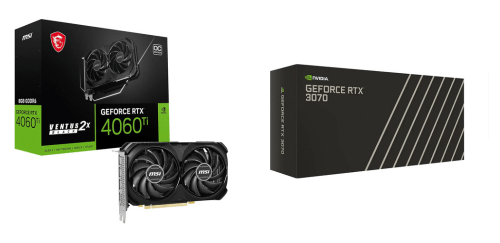
Why Do I Recommend The GeForce RTX 4060 Ti?
- The GeForce RTX 4060 Ti features DLSS 3 Frame Generation to significantly boost perceived frame rates and smoothness in supported games, while the GeForce RTX 3070 supports DLSS 2 without frame generation.
- GeForce RTX 4060 Ti comes with Ada Lovelace architecture for higher performance per watt and improved efficiency in long gaming sessions, whereas the GeForce RTX 3070 uses the older Ampere architecture.
- It includes fourth-generation Tensor Cores to accelerate AI-driven upscaling and image reconstruction with greater accuracy, while the GeForce RTX 3070 comes with third-generation Tensor Cores.
- The GeForce RTX 4060 Ti has third-generation ray tracing cores for faster and more efficient real-time lighting and reflections, whereas the GeForce RTX 3070 uses second-generation ray tracing cores.
- GeForce RTX 4060 Ti supports AV1 hardware encoding to deliver higher-quality streams and recordings at lower bitrates, while the GeForce RTX 3070 lacks AV1 encoding support.
- It comes with a much larger L2 cache to reduce memory latency and improve performance consistency in modern games, while the GeForce RTX 3070 has a significantly smaller cache.
- The GeForce RTX 4060 Ti features substantially lower power consumption to enable quieter cooling and smaller power supply requirements, while the GeForce RTX 3070 draws noticeably more power.
- GeForce RTX 4060 Ti supports an optional 16GB VRAM configuration to better handle future games with large textures and higher memory demands, whereas the GeForce RTX 3070 is limited to 8GB of VRAM.
Maybe the GeForce RTX 3070 price can make you comfortable because it’s a little bit cheaper than the GeForce RTX 4060 Ti. But you have to compromise all the above-mentioned features. Now the Decision is Yours. I hope it was helpful to choose the right one.
Side By Side Comparison
| Feature | GeForce RTX 4060 Ti | GeForce RTX 3070 |
| Architecture | Ada Lovelace | Ampere |
| Process Node | TSMC 4N | Samsung 8nm |
| CUDA Cores | 4352 | 5888 |
| Base Clock | ~2310 MHz | ~1500 MHz |
| Boost Clock | ~2535 MHz | ~1725 MHz |
| Memory Capacity | 8GB / 16GB | 8GB |
| L2 Cache | 32 MB | 4 MB |
| PCIe Interface | PCIe 4.0 x8 | PCIe 4.0 x16 |
| Ray Tracing Cores | 3rd Gen | 2nd Gen |
| Tensor Cores | 4th Gen | 3rd Gen |
| DLSS Support | DLSS 3 | DLSS 2 |
| AV1 Encoding | Yes | No |
| Transistor Count | ~22.9B | ~17.4B |
| Launch MSRP Tier | Mid-range | Upper mid-range |
| Price | Check 4060 Ti Price | Check RTX 3070 Price |
Common Features
| Feature | GeForce RTX 4060 Ti | GeForce RTX 3070 |
| NVIDIA GeForce RTX Series | Yes | Yes |
| Desktop GPU Segment | Yes | Yes |
| PCI Express 4.0 Support | Yes | Yes |
| GDDR6 Memory Type | Yes | Yes |
| Hardware Ray Tracing | Yes | Yes |
| Tensor Cores for AI | Yes | Yes |
| NVIDIA DLSS Support | Yes | Yes |
| NVIDIA Reflex | Yes | Yes |
| NVIDIA Ansel | Yes | Yes |
| NVIDIA Broadcast | Yes | Yes |
| DirectX 12 Ultimate | Yes | Yes |
| Vulkan API Support | Yes | Yes |
| OpenGL Support | Yes | Yes |
| HDMI 2.1 Output | Yes | Yes |
| DisplayPort 1.4a | Yes | Yes |
| Multi-Monitor Support | Yes | Yes |
| VR Ready Certification | Yes | Yes |
| Hardware Video Decoding | Yes | Yes |
| Price | Check 4060 Ti Price | Check RTX 3070 Price |